Tuesday, June 5, 2018

The Era of Good Feelings?

The paper I discussed in my last post showed changes in an index of "racial resentment" from the American National Election Studies, which rose in 2008 and 2012.  The authors interpreted this as evidence that whites felt the presidency of Barack Obama as a threat to their status.  That reminded me that I had a post mentioning the index several years ago.  The index is the sum of responses (strongly agree .... strongly disagree, reverse coded for #2 and #3) to the following statements:

   1. Generations of slavery and discrimination have created conditions that make it difficult for blacks to work their way out of the lower class.
   2. Irish, Italian, Jewish, and many other minorities overcame prejudice and worked their way up.  Blacks should do the same without any special favors.
   3. It's really a matter of some people not trying hard enough; if blacks would only try harder they could be just as well off as whites.
  4. Over the past few years, blacks have gotten less than they deserve.

At the time, I said "this scale certainly measures something of interest, but 'resentment' doesn't seem like the right term."  That was just my feeling based on reading the questions--does the data shed any light on the issue?   Let's start with looking at changes (among whites) over the entire period covered by the ANES:


So either racial resentment fell dramatically among whites in 2016, or the index doesn't really measure racial resentment.  The first interpretation doesn't seem very plausible, but the ANES survey has two parts, one of which takes place after the election, and that's the part in which these questions were asked.  So you could say that perhaps white fears of threats to their status fell after Trump was elected.  If we break it down by the party that people voted for (non-Hispanic whites only):


From 1988 through 2012, the means for Republican voters gradually rose and the means for Democrats fell, which is to be expected given general ideological polarization over the period.  The elections of 2008 and 2012 don't stand out as unusual.  Then in 2016, the mean fell a little among Republican voters, and a lot among Democratic voters.  The first change is consistent with the idea that people who would otherwise have felt threatened were reassured because they had a president who would look after them, but the second is puzzling from that point of view.  You would have to say that Democratic voters were the ones who were secretly yearning for a protector, and felt most reassured by Trump's win. 

So I stand by my earlier thought that this index doesn't measure resentment.  My next post will offer some thoughts on what it does measure.   

Sunday, June 3, 2018

Explaining too much

In the last few days, I have seen several stories saying that "a new study ... found that opposition to welfare ... has grown among white Americans."  The study (by Rachel Wetts and Robb Willer) didn't actually show any figures on opposition to welfare--it focused on changes in the gap between white and non-white opinions--but I can see how journalists would have that interpretation.  The abstract says:  "we find that whites’ racial resentment increased beginning in 2008, the year of Barack Obama’s successful presidential candidacy and a major economic downturn, the latter a factor previously shown to amplify racial threat effects. . . . These findings suggest that whites’ perceptions that minorities’ standing is rising can produce periods of 'welfare backlash' in which adoption of policies restricting or curtailing welfare programs is more likely."

Has opposition to welfare grown?  Here are the means for whites and blacks in a question from the General Social Survey about whether we are spending too much [3], too little [1], or about the right amount [2] on welfare.


White opinion moved in the "too much" direction after Obama's election, but so did black opinion.  Looking over a longer period, white opinion has moved up and down, and is more favorable to welfare spending than in the 1970s and most of the 1990s.  Black opinion has also gone up and down, but there seems to be a gradual shift towards "too much."

If you look more closely, it seems that the ups and downs are related to the party of the president:  people tend to say "too much" when a Democrat is president, "too little" when a Republican is.  Presumably this is because, rightly or wrongly, they perceive the government as doing more when a Democrat is in office.  This is a well-known pattern that has been documented in research on a variety of issues.  So what mattered was Obama's party, not his race (see this post for another example).

If you regress average opinions on party in power and a time trend, you get the following predicted values:

There is a clear trend towards less opposition among whites and more opposition among blacks, so the racial gap in opinions is gradually declining.  The effects of party control are almost the same among blacks and whites.  I didn't investigate systematically, but it doesn't appear that general economic conditions have any effect among either blacks or whites.

The paper proposed that whites would also regard the rising share of non-whites in the population as a threat.  Since this changes gradually from year to year, that would lead to gradually rising opposition to welfare among whites.  The actual trend is in the opposite direction from the predicted one.

The hypothesis that underlies the paper is that when "relative advantage in the racial status hierarchy" is threatened, whites turn against programs that are seen as helping minorities.  I think the general hypothesis is probably right--the other part of their paper provides pretty convincing experimental evidence that whites express more negative views on welfare when they are made to think about the prospect of America as a "majority minority" nation.  But although perceived threat may help to explain differences among people at a given point in time (e. g., between different places), when looking at historical change it is overwhelmed by the effect of a general decline of racial prejudice. 


Technical note:
1.  Wetts and Willer use a question on welfare spending from the American National Election Studies.  I used a very similar question from the General Social Survey, mostly because the question has been asked for a longer period of time and the GSS has a convenient cumulative file.
2.  My "white" category includes people who also report that they are Hispanic.  That probably accounts for some of the trend among whites.  If I were writing a paper, I would distinguish between Hispanic and non-Hispanic whites and maybe add some other controls, but since I am writing a blog post I will just say that I don't think it accounts for much of the trend.


Friday, May 25, 2018

Democracy and public support for democracy

A recent piece by Thomas Edsall in the New York Times discusses research by Steven Miller and Nicholas Davis.  They find that "outgroup intolerance" is associated with lower support for democracy.  Edsall also says that intolerance is on the rise:  "The percentage of whites who qualified as socially intolerant doubled from 12.6 percent in 1995 to 24.9 percent in 2011."  I'm sure that his claim about a dramatic rise in social intolerance is a mistake:  it doesn't appear in the Miller/Davis paper and is inconsistent with data from their source, the World Values Survey.  But rather than trying to figure out where it came from, I want to pursue a more general point.  He quotes Miller and Davis as saying until now, there had been little "serious inquiry" into American attitudes towards democracy, but that "a recent and growing scholarly literature raises questions regarding the depths of citizens’ support for democracy."  Although the recent literature undoubtedly adds something, I think there has been a good deal of serious inquiry starting in the 1950s, and it yields a pretty clear picture.

1.  Tolerance and egalitarianism (in the sense of support for equal rights) have grown pretty steadily, and continues to grow.  This is happening among all major segments of the population, even the fabled white working class.  That's the good news. 
2.  However, popular support for democracy has always been pretty shallow.  Or maybe something like "unsteady" would be better--people may be strongly attached to the general idea of democracy, but they don't necessarily support the things it needs to work.  For example, in 2001 a survey asked people how they felt about the statement "Newspapers should be allowed to endorse candidates for public office":  39% disagreed, and the proportion who strongly disagreed (28%) was almost equal to the propotion who strongly agreed (30%).  In 2007, people were asked about the statement "Newspapers should be allowed to freely criticize the US (United States) military about its strategy and performance:  37% disagreed.  In 2002, people were asked about the statement "Newspapers should be allowed to publish freely without government approval of a story":  27% disagreed.  That is, a substantial number of people don't support some of the most basic activities of a free press.
3.   Most of the time, political elites have not appealed to anti-democratic sentiments, and have (eventually) united against anyone who does.  I've talked about the case of Joe McCarthy in this post:  the Senate censured him by a vote of 67-22 even though he still had substantial support in the public (45% favorable, 35% unfavorable).

Why had Donald Trump been successful so far?  I think it's not because of a rise in anti-democratic sentiments among the public, but because of changes in political elites.  One important difference from the situation with McCarthy is that Trump is President, and the costs of going against a President are greater than the costs of going against a Senator.  That reflects a change in political institutions: before the 1970s, someone like Trump could not have become the nominee of a major party, because most of the convention delegates were selected by party leaders, not in primaries.  A second difference is that political elites are more reluctant to join with the other party against one of their own.  A third difference is that the public has less trust in political elites--as a result, Republicans in Congress might reasonably suspect that Trump's supporters in the public would stick with him regardless of what they do.   So Trump has appealed to a current of opinion that has always been there, but which until now politicians of both parties have neglected rather than encouraged.

[Data from the Roper Center for Public Opinion Research]

Tuesday, May 22, 2018

Elites or Masses?

One popular view of the 2016 election is that liberal elites drove voters away by lack of respect--here is a recent story .  This is not a new idea--back in the infancy of this blog (October 2010) I had a post inspired by a New York Times story entitled "Elitism:  the Charge Obama Can't Shake."  At that time, I found very few survey questions that mentioned elites or elitism.  Despite the amount of discussion of the subject, few additional ones have appeared, and I haven't found any from the 2016 election (although there was one on respect for various kinds of people, which I discuss in this post). 

However, I recently discovered one from a Fox News poll from October 2008:  "Thinking about your friends and neighbors, would they consider themselves to be part of the top elite in this country or are they part of a group that the elites in America look down upon?"  17% said part of the elite, 41% part of the group that the elites look down on, 22% gave answers that were described as "mix/depends" and 20% said they didn't know.  I found a report  that breaks it down by party identification:

                                    Elite            Despised      Depends/DK           
Democrat                     18%             44%              38%
Republican                   19%             37%             44%
Independent                 13%             44%              43%

In the sample, Republicans were most likely to think their friends were in the "top elite," and least likely to think they were in the group that elites looked down on, although none of the differences were statistically significant.  This does not fit with the usual story about Republican resentment of what liberal elitism.  The number of don't know and other answers is also noteworthy--it's unusual for 40% of people to say they don't know or volunteer another response, and suggests that the question didn't make sense to a lot of people.  (Maybe this is why they never repeated the it). 

I have a hypothesis:  that resentment about the lack of respect from liberal elites is strong not in the general public, or in the working class, but in conservative elites.  Most people don't know about the story in the latest issue of the New Yorker, or the recent incident at the University of ******, and wouldn't care very much if they did.  Conservative elites know and care.  The question is whether this sentiment is limited to a small group--a real elite--or whether some of it has filtered down to the larger group of college-educated conservatives.  Unfortunately, the original data don't seem to be available.

[Data from the Roper Center for Public Opinion Research]

Wednesday, May 16, 2018

Fully, accurately, and fairly

In 1972, a survey conducted by the Gallup Poll asked "how much trust and confidence do you have in the mass media--such as newspapers, TV and radio--when it comes to reporting the news fully, accurately, and fairly--a great deal, a fair amount, not very much, or none at all?"  The question was asked again in 1974 and 1976.  Then there was a long gap until it was asked again in 1997, but since that time it has been asked pretty regularly.  The means, with a great deal=4 .... none at all=1:


There were a few surveys which asked about the "news media" rather than the "mass media":  they are shown in red.

In December 2016, I wrote about other Gallup questions about confidence in various institutions, include newspapers and TV news.  Both showed a downward trend, so it's not surprising that confidence in the "mass media" does too.  However, the  question that I just discovered helps to shed light on the nature of the trend.  The following graph shows them all together (the mean is adjusted so it'a on a comparable scale):


With newspapers, there is an unusually high figure in one year (1979).  If you exclude that, there is very little trend from the 1970s until the early 2000s.  Similarly, TV has one unusually high year, which happens to be the first year it was asked, and then no trend until to the early 2000s.  When you add the question on the media, it's pretty clear that there was a decline from the 1970s to the 1990s, but that confidence then held up for several years before starting to decline again.

Another interesting point is that confidence in the media rose from 2016 to 2017 (September in both years).  This also happened with confidence in newspapers and TV news.  An obvious possibility is that the gain was a result of reporting on Donald Trump.  That might have pleased some liberals who in 2016 thought that the media was too hard on Hillary Clinton and/or Bernie Sanders.  I think there may also be a general tendency for it to be lower in election years:  it rose between 2012 and 2013, 2008 and 2009, and 2004 and 2005 (it was the same in 2000 and 2001).  That could be because people get tired of "horse race" coverage.

[Data from the Roper Center for Public Opinion Research]

Saturday, May 12, 2018

What's the alternative?

I saw one more article on culture vs. economics in the 2016 election and thought I should say more about my own position.  One popular view, which is advocated in the article by Diana Mutz that I have mentioned in previous posts, it that support for Donald Trump was not driven by economic distress.  Mutz pointed out that economic conditions were considerably better in 2016 than they had been in 2012 or 2008.   Another popular view, which is advocated in the latest article (by Dave Leonhardt) is that the lack of economic progress for less educated people over the last 40 years produced a gradual buildup of anger and frustration--Trump appealed to that feeling, and turned it against immigrants and racial minorities.  So they agree about the immediate motivations of Trump voters--racial and ethnic fears, and they agree that those fears stemmed from distress about the way things were going in the country; where they differ is on their ultimate source.

I don't agree with either of these analyses.  First, there is no evidence that people were particularly discontented with the way things were going in the country (see this post).  Second, opinions are not becoming more hostile to immigrants or racial minorities (see this post, among others).  Of course, race and ethnicity played an important role in this election, but they always do.  What was different about 2016?  I think it was the very low level of confidence in government.  That made people more interested in outsiders.  Also, there are a number of issues on which public opinion consistently diverges from policy.  An important example is immigration--people always think that more should be done to prevent illegal immigration.  Another important example is trade--people always are suspicious of trade agreements, and suspect that other countries are taking advantage of us.  However, when confidence in government is high, people are willing to give it some slack, and accept assurances that this particular trade agreement is good, or that the government is doing all that it reasonably can to stop illegal immigration.  When confidence is low, they'll credit claims that government officials are selling us out. 

I have calculated a measure of confidence in government which indicates that it fell to low levels in the early 1990s and then rebounded before falling to even lower levels in 2016.  A paper by J. Eric Oliver and Wendy Rahn calculates a measure of confidence which uses different data sources, but shows the same pattern.  While 2016 had Donald Trump, 1992 had another outsider candidate, Ross Perot.  Although he didn't have much lasting impact, Perot's electoral performance was arguably more impressive than Trump's.  He got almost 19% of the vote, which was the most by any third-party candidate since Theodore Roosevelt in 1912.  Unlike the other third party candidates who cleared 10% (Roosevelt, Robert LaFollette, and George Wallace) Perot had no political experience and lacked a regional base.  He was not particularly charismatic, and was much less well-known than Trump when he started his race.  The most plausible explanation for his strong performance is that voters were looking for an outsider.

Although Perot appealed to the same nationalist sentiments that Trump did, he drew about evenly from all educational levels.  On that point, I think that the difference is style.  Perot was kind of eccentric, but basically conducted himself as a "respectable" candidate; Trump didn't.   

I think this account makes sense of a lot of things, but there is one aspect still puzzles me.  It's easy to understand why people lacked confidence in government in 2016, but not why they did in the early 1990s. 

Tuesday, May 8, 2018

Other cultures

Last week I had a post on the idea that Donald Trump's gains among "working-class" (less educated) white voters were because of their anxiety about maintaining social dominance.  I mentioned that I wasn't convinced by the paper by Diana Mutz  that has been cited in support of this claim, but I didn't go into detail.  Yesterday I saw a piece by Andrew Cherlin in the New York Times, which said that "these conclusions, faithful as they may be to the survey data that underlie them, exemplify a misguided debate about whether culture or economics was the driving force in Mr. Trump’s win."  I agree that the debate is misguided--I've had a number of posts arguing that public opinion about economics includes a large dose of moral considerations.  However, I don't agree that the conclusions about social dominance are faithful to the survey data.

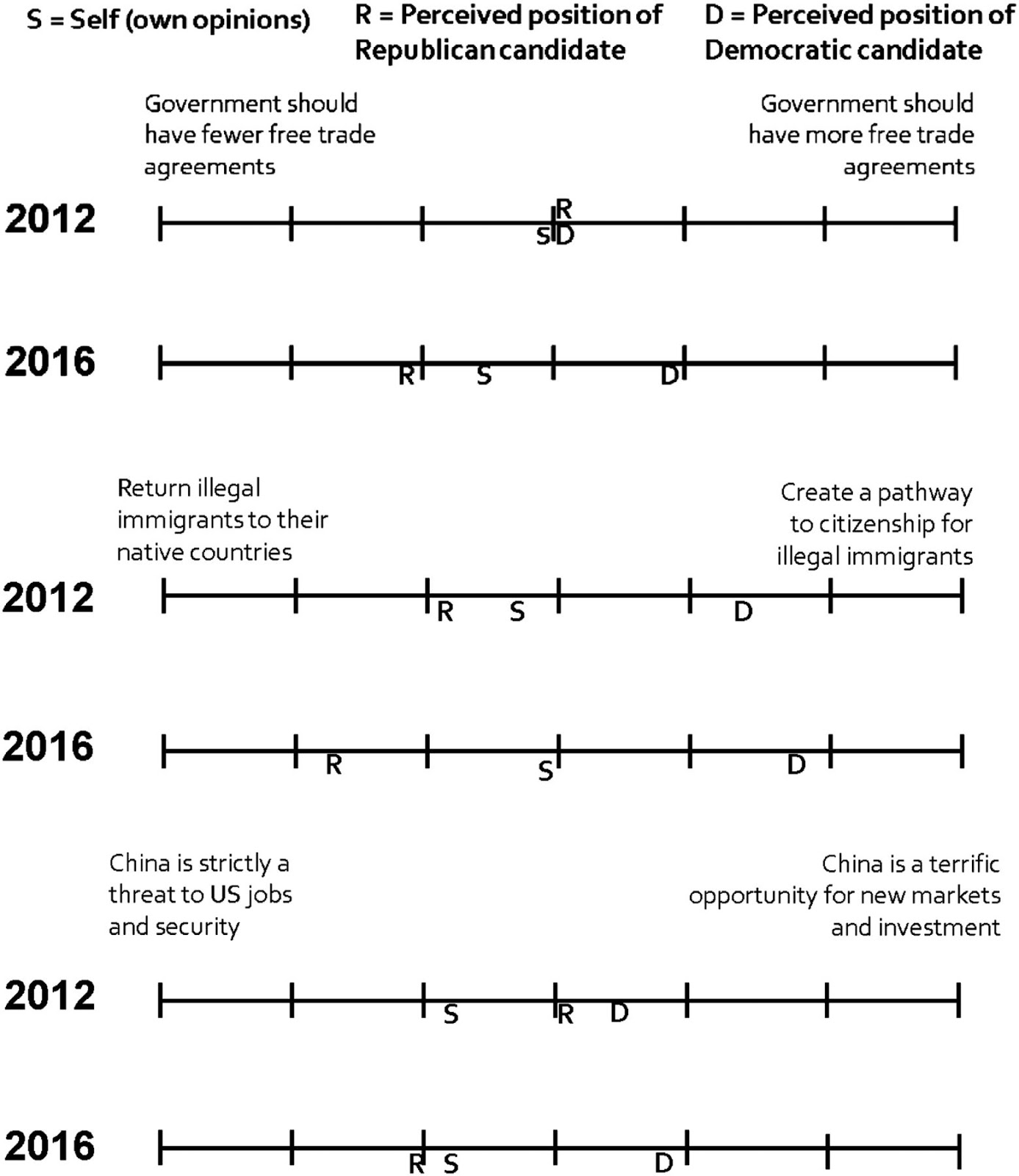
Mutz had a panel survey--the same people were asked the same questions in 2012 and 2016.  She found that "switches" (Obama in 2012 and Trump in 2016 or Romney in 2012 and Clinton in 2016) could be explained by position on three issues:  free trade, deportation vs. path to citizenship, and view of China as a threat or economic opportunity.  For each one, people were asked what they thought the position of the Democratic and Republican candidate was, as well as about their own position. 


Between 2012 and 2016, voters moved away from support for free trade and towards support for a path to citizenship.  The first shift helped Trump, while the second helped Clinton.  The overall effects of those two shifts almost exactly offset each other.  On China, there was no change in average public opinion, but the perceived position of the Republican candidate moved in the direction of average public opinion.  That is, Trump took the popular position on China, which helped him. 

That's the data--now on to the interpretation.  Mutz says that anxiety about social dominance should make people turn against "outsiders"--that is, against trade, against illegal immigrants, and against China.  People did turn against trade agreements, but became more sympathetic to illegal immigrants and didn't change on China.  So in terms of the hypothesis, one change was in the expected direction, one was in the "wrong" direction, and one didn't change.  In other words, what actually happened didn't match what should have happened if people were defending social dominance.   

What's my interpretation?  Social scientists are always attracted to the idea of having an interpretation that ties different things together, but I don't think that's possible here.  For immigration, the move continues a long-term shift towards more "liberal" views (the opposite of what the social dominance hypothesis predicts).  For trade, I think it was a short-term change resulting from the combination of criticism from Trump and Bernie Sanders, and the lack of a strong defense from Clinton.  And on China, there's an enduring gap between public opinion, which is tends to be sympathetic towards "America First" positions, and elite opinion, which tends to be more internationalist.  Trump seized an opportunity that previous candidates (except Ross Perot) had ignored.