In the New York Times last week, Nate Cohn writes "The polls don’t tell a clear story [about public opinion on affirmative action]. Some polls show that affirmative action is very popular. Others show that it’s not popular at all." I think that they tell a pretty clear story--a large majority of people don't think that race should be considered in college admission. The difference among polls occurs because "affirmative action" covers a lot of things, and some of them are popular--for example, special efforts at outreach to minorities.
There's a related issue that hasn't received much attention--how do people think that things actually work? In 2003, 2005, and twice in 2007 the Gallup Poll asked "If two equally qualified students, one white and one black, applied to a major U.S. (United States) college or university, who do you think would have the better chance of being accepted to the college--the white student, the black student--or would they have the same chance?" The distribution of answers was similar on all occasions, so I'll just give the average:
White Black Same DK
30% 23% 42% 5%
Unfortunately the individual-level data aren't available for any of the polls, but even if you make the extreme assumption that every black respondent said that the white student would have the better chance, less than 30% of whites said that the black student would have a better chance.
[Data from the Roper Center for Public Opinion Research]
Saturday, August 12, 2017

Friday, August 4, 2017
Households or people
In last Sunday's New York Times, Paul Campos (a professor at the University of Colorado law school) says that "the gap between black and white Americans at every income level, remains every bit as extreme as it was five decades ago." He shows figures of the income ratio of households at the 20th, 40th, 60th, 80th, and 95th percentiles of the black and white income distribution, and they are indeed all virtually unchanged.
Here is a figure he didn't show: the ratio of per-capita income for blacks relative to per-capita income for whites.
 There is a clear and pretty steady increase in the ratio of average black to white income--that is, the gap has declined. Why the difference? Campos was comparing households, which may (and usually do) include more than one person. Average household size has been declining in the United States over the last fifty years--the biggest reasons are later marriage and longer lifespans. The most plausible way to reconcile the two trends is that average household size has declined more for blacks than for whites.
What is the best way to measure the "gap between black and white Americans?" You could argue that per-capita income is not the ideal measure--maybe it should be adjusted for age--but it certainly would involve people rather than households.
Campos's general point is that the slow growth of incomes for working-class and middle-class whites in the last couple of decades isn't because blacks have been doing well. This is true--the only group that has had rapid income growth recently is people with high incomes. But the gap in black and white incomes has declined, although the decline has been slow.
PS: The Census data black and white income is at
https://www.census.gov/data/tables/time-series/demo/income-poverty/historical-income-households.html
and
https://www.census.gov/data/tables/time-series/demo/income-poverty/historical-income-people.html
Here is a figure he didn't show: the ratio of per-capita income for blacks relative to per-capita income for whites.

What is the best way to measure the "gap between black and white Americans?" You could argue that per-capita income is not the ideal measure--maybe it should be adjusted for age--but it certainly would involve people rather than households.
Campos's general point is that the slow growth of incomes for working-class and middle-class whites in the last couple of decades isn't because blacks have been doing well. This is true--the only group that has had rapid income growth recently is people with high incomes. But the gap in black and white incomes has declined, although the decline has been slow.
PS: The Census data black and white income is at
https://www.census.gov/data/tables/time-series/demo/income-poverty/historical-income-households.html
and
https://www.census.gov/data/tables/time-series/demo/income-poverty/historical-income-people.html
Friday, July 28, 2017
Livin' in the USA
This came to mind when I was composing a post in which I said that "American society has become a lot more egalitarian over the last 60 years or so." It didn't quite fit there, but I thought it still deserved a spot.
When Chuck Berry died in March 2017, the New York Times gave him and his contributions to American popular music a lot of attention. That led me to wonder how much coverage they gave him when he was making hit records. In the 1950s, he got only one mention, in a brief (four-sentence) wire service story on August 29, 1959 entitled "Negro Singer Jailed| Accused of trying to date Mississippi white girl." After playing a dance, Berry allegedly asked a young woman (aged 20) for a date. He said it was a misunderstanding, but was held without bond "while authorities conducted an investigation." The story explained that Berry "was popular among the high school set for recordings such as 'Maybellene' and 'Memphis, Tennessee.'"
The next mention came in September 1963, when he was included in a list of rhythm and blues musicians. There were a few more incidental mentions in 1965. Overall, it's clear that in the late 1950s and early 1960s, the New York Times didn't think that Chuck Berry was someone that its readers would or should know about.
When Chuck Berry died in March 2017, the New York Times gave him and his contributions to American popular music a lot of attention. That led me to wonder how much coverage they gave him when he was making hit records. In the 1950s, he got only one mention, in a brief (four-sentence) wire service story on August 29, 1959 entitled "Negro Singer Jailed| Accused of trying to date Mississippi white girl." After playing a dance, Berry allegedly asked a young woman (aged 20) for a date. He said it was a misunderstanding, but was held without bond "while authorities conducted an investigation." The story explained that Berry "was popular among the high school set for recordings such as 'Maybellene' and 'Memphis, Tennessee.'"
The next mention came in September 1963, when he was included in a list of rhythm and blues musicians. There were a few more incidental mentions in 1965. Overall, it's clear that in the late 1950s and early 1960s, the New York Times didn't think that Chuck Berry was someone that its readers would or should know about.
Wednesday, July 19, 2017
The neoliberal period, part 2
As discussed in my last post, spending directed at helping the poor has increased, not declined, in the "neoliberal period" (since 1980). What about regulation of business? I found a study that gives estimates of federal spending on regulation since 1960. It distinguishes between "social regulation," which "includes regulatory agencies that address issues related to "health, safety, and the environment" and "economic regulation," which "is more likely to be industry-specific." Here are the figures for spending on economic and social regulation (excluding homeland security) in constant (2009) dollars.
 Both types grew rapidly in the 1960s. Spending on economic regulation has grown less rapidly since 1970, and spending on social regulation since 1980, but both have grown. Of course, the economy has grown too--social regulation has stayed about the same relative to the economy as a whole, while economic regulation has grown somewhat. This just measures the amount of spending, not the effect of regulation (and it doesn't count state and local spending), so the figures are just a rough estimate. However, they aren't consistent with the claim that there's been a general move to the right.
So can we discard the whole idea of "neoliberalism"? I wish the answer were yes, because I dislike the term (partly because there are too many "neo" and "post" terms already, and partly because it is bound to be confusing to most Americans, since the "liberalism" involved is pretty much the opposite of what we now mean by liberalism). However, there is a germ of truth in it. The report distinguished between "financial," "general business," and "industry-specific" regulation. Spending on the first two increased pretty steadily, but spending on "industry-specific" regulation fell between 1970 and 1980, and didn't reach its 1970 level until 2000. As a share of the economy, it's now less than it was in 1960. At one time, there was a lot of regulation of prices and operations in industries like airlines, interstate trucking, and communications. This was cut back in the late 1970s, and much of it hasn't been restored. As I recall, the deregulation movement was supported by both conservatives and a significant number of liberals (who argued that regulatory agencies tended to be "captured" by the industries they were supposed to regulate). You could say that the newer form of liberalism is more inclined to accept that markets are an effective way of producing goods and services, but not more inclined to accept the market distribution of income. This is an important change, but it's not a simple move to the right.

So can we discard the whole idea of "neoliberalism"? I wish the answer were yes, because I dislike the term (partly because there are too many "neo" and "post" terms already, and partly because it is bound to be confusing to most Americans, since the "liberalism" involved is pretty much the opposite of what we now mean by liberalism). However, there is a germ of truth in it. The report distinguished between "financial," "general business," and "industry-specific" regulation. Spending on the first two increased pretty steadily, but spending on "industry-specific" regulation fell between 1970 and 1980, and didn't reach its 1970 level until 2000. As a share of the economy, it's now less than it was in 1960. At one time, there was a lot of regulation of prices and operations in industries like airlines, interstate trucking, and communications. This was cut back in the late 1970s, and much of it hasn't been restored. As I recall, the deregulation movement was supported by both conservatives and a significant number of liberals (who argued that regulatory agencies tended to be "captured" by the industries they were supposed to regulate). You could say that the newer form of liberalism is more inclined to accept that markets are an effective way of producing goods and services, but not more inclined to accept the market distribution of income. This is an important change, but it's not a simple move to the right.
Wednesday, July 12, 2017
The neoliberal period, part 1
In an interview published in the New York Times last week, Noam Chomsky spoke of "the shift of both parties to the right during the neoliberal period." There's nothing remarkable about that--I've read many similar statements--but for some reason I started wondering what you would find if you looked for evidence of a move to the right.
A reasonable basic definition of left and right (on economic issues) is that the left is in favor of direct government assistance to the poor. One major program of assistance to the poor is food stamps (SNAP). The figure shows real per-capita spending on food stamps (2010 dollars) between 1969 and 2016. It was about 70% higher in 2016 than in 1981, the year Ronald Reagan became president.

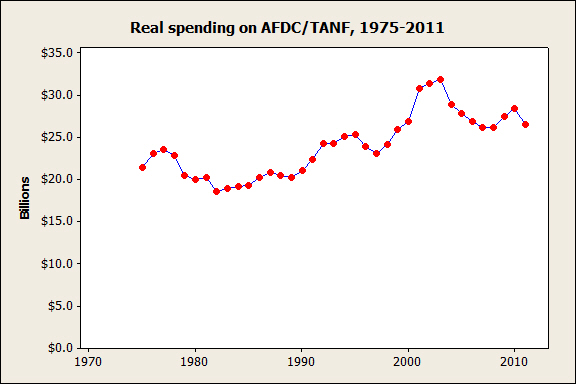
As everyone knows, Bill Clinton promised to "end welfare as we know it," and in 1996 signed a bill placing restrictions on welfare. This figure shows federal spending on AFDC/TANF from 1975 to 2011. There has been a slight upward trend since 1981, but the population has grown too, so basically there has been little change. It is interesting that the 1996 reform didn't have any obvious impact on spending.

Two other programs that aid poor people are the Earned Income Tax Credit and the Child Tax Credit.

Spending on both has increased greatly during the "neoliberal period" (the CTC didn't exist until 1997). Also notice the numbers on the vertical axis--total spending on the EITC and CTC is now about four times as large as TANF.
For disability, see this report. Both the percent of working-age people getting disability and the average payments per recipient have increased pretty steadily since 1970.
Spending to help the poor has increased substantially the "neoliberal period." You could argue about whether this change should be called a move to the left in policy--declining work opportunities for less skilled people means more government assistance is needed to produce the same standard of living for the poor. But it's not a move to the right.
What about regulation of business? I'll look at that in my next post.
Sources: SNAP
EITC, CTC, and AFDC/TANF.
A reasonable basic definition of left and right (on economic issues) is that the left is in favor of direct government assistance to the poor. One major program of assistance to the poor is food stamps (SNAP). The figure shows real per-capita spending on food stamps (2010 dollars) between 1969 and 2016. It was about 70% higher in 2016 than in 1981, the year Ronald Reagan became president.

As everyone knows, Bill Clinton promised to "end welfare as we know it," and in 1996 signed a bill placing restrictions on welfare. This figure shows federal spending on AFDC/TANF from 1975 to 2011. There has been a slight upward trend since 1981, but the population has grown too, so basically there has been little change. It is interesting that the 1996 reform didn't have any obvious impact on spending.
Two other programs that aid poor people are the Earned Income Tax Credit and the Child Tax Credit.

Spending on both has increased greatly during the "neoliberal period" (the CTC didn't exist until 1997). Also notice the numbers on the vertical axis--total spending on the EITC and CTC is now about four times as large as TANF.
For disability, see this report. Both the percent of working-age people getting disability and the average payments per recipient have increased pretty steadily since 1970.
Spending to help the poor has increased substantially the "neoliberal period." You could argue about whether this change should be called a move to the left in policy--declining work opportunities for less skilled people means more government assistance is needed to produce the same standard of living for the poor. But it's not a move to the right.
What about regulation of business? I'll look at that in my next post.
Sources: SNAP
EITC, CTC, and AFDC/TANF.
Monday, July 3, 2017
It is what it is
In his speech announcing that he was pulling out of the Paris climate agreement, Donald Trump said something to the effect that other countries were taking advantage of the United States. That led me to wonder if there were any survey questions on that issue. I found one, in a 1999 Pew survey. People were offered two statements, "Other countries generally treat the United States about as fairly as we treat them"
OR...
"Other countries often take unfair advantage of the United States" and asked which they agreed with more.
After they made a choice, they were asked if they felt strongly.
Among people who had graduated from high school but not gone to college, about 20% agreed with the first statement and 75% with the second; among people with graduate education, 44% agreed with the first, and 50% with the second. The item was part of a series of about 12 with the same format, covering a variety of issues. The correlation between education and opinions on fair treatment vs. take advantage was the strongest of all items, with one exception: whether immigrants strengthen the country or are a burden on the country.
Most analyses of Trump's appeal to less educated voters hold that it was about race, or gender, or a long period of slow wage growth. The alternative, that it was about what he talked about--taking a hard line on immigration and following an "America first" policy--hasn't gotten much attention. But as these questions show, there's a lot of support for those general sentiments, especially among less educated people. Opinions on immigration have become more favorable, as I have noted, but are still mostly negative. Unfortunately the fair treatment/take advantage question has not been repeated, but I was surprised to see how lopsided the distribution of opinions was--even among people with graduate degrees, people who thought that other countries took unfair advantage were more numerous and more likely to feel strongly about it. Trump seems to have found a strong current of opinion that no one else had tried to appeal to. Although comparable questions are not available for a long period of time, there is some evidence that it has been around for quite a while.
[Data from the Roper Center for Public Opinion Research]
OR...
"Other countries often take unfair advantage of the United States" and asked which they agreed with more.
After they made a choice, they were asked if they felt strongly.
Among people who had graduated from high school but not gone to college, about 20% agreed with the first statement and 75% with the second; among people with graduate education, 44% agreed with the first, and 50% with the second. The item was part of a series of about 12 with the same format, covering a variety of issues. The correlation between education and opinions on fair treatment vs. take advantage was the strongest of all items, with one exception: whether immigrants strengthen the country or are a burden on the country.
Most analyses of Trump's appeal to less educated voters hold that it was about race, or gender, or a long period of slow wage growth. The alternative, that it was about what he talked about--taking a hard line on immigration and following an "America first" policy--hasn't gotten much attention. But as these questions show, there's a lot of support for those general sentiments, especially among less educated people. Opinions on immigration have become more favorable, as I have noted, but are still mostly negative. Unfortunately the fair treatment/take advantage question has not been repeated, but I was surprised to see how lopsided the distribution of opinions was--even among people with graduate degrees, people who thought that other countries took unfair advantage were more numerous and more likely to feel strongly about it. Trump seems to have found a strong current of opinion that no one else had tried to appeal to. Although comparable questions are not available for a long period of time, there is some evidence that it has been around for quite a while.
[Data from the Roper Center for Public Opinion Research]
Saturday, June 24, 2017
Now for some speculation
According to exit polls, Donald Trump got 67% of the vote among whites without a college degree in 2016, which may be the best-ever performance by a Republican (Reagan got 66% of that group in 1984). What explains Trump's support among less educated voters? One popular idea is that he cared about them, or at least gave them the impression that he cared. The popularity of this account has puzzled me, because it's not even superficially plausible. Every other presidential candidate I can remember tried to show empathy by talking about people they had met on the campaign trail, or tough times they had encountered in their past, or how their parents taught them to treat everyone equally. Trump didn't do any of that--he boasted about how smart and how rich he was.
A variant is that Democrats drove "working class" voters away by showing contempt for them. This is more plausible, but raises the question of whether Democrats showed that much more contempt in 2016 than in 2012, 2008, 2004, etc. That seems like a hard case to make--at any rate, I haven't heard anyone try to make it.
So why are these explanations so popular? My hypothesis is that it's because American society has become a lot more socially egalitarian over the last 60 years or so. Educated people don't want to be thought of as snobs or elitists, and less educated people are less likely to think they should "improve themselves" by emulating the middle class. At one time, you could say that Democrats thought of themselves as the party of the common people, and Republicans thought of themselves as the party of successful people. Now both parties think of themselves as the party of the common people, plus the fraction of the elites who care about or understand the common people. The result is that people are attracted to an explanation that is more flattering to the "working class." When thinking about this, it occurred to me that I've seen many books and articles on how the Republicans can win over working-class voters, but nothing on how they can win back the kind of educated people who used to vote Republican. That is, gaining working-class voters is thought of as a more worthy goal than gaining middle class voters.
There are two possible objections to my account. First, it's easy to point to examples of condescension and contempt today. My reply is that there was probably always a lot of this in everyday political discussion, and that social media has just made it more visible for those who are paying attention. A second is the recollections of people like Charles Murray (Coming Apart) and Robert Putnam (Our Kids) about how there used to be less social distance between classes. I think that may be because they both grew up in small towns in the Midwest. If you read something like E. Digby Baltzell's The Protestant Establishment, you get a very different picture of status differences in America.
Subscribe to:
Posts (Atom)