The Electoral College has been in the news recently. I am going to write a post about public opinion on the Electoral College vs. popular vote, but I was diverted into writing about the arguments offered in favor of it. An editorial in the National Review says "it prevents New York and California from imposing their will on the rest of the country." Taken literally, that is ridiculous--those two states combined had about 16% of the popular vote in 2016. But presumably the general idea is that the Electoral College makes it harder for a small number of large states to provide a victory. That is true--the less populated states get a bonus because of Senate seats. How much difference does that make? In 2016, 52% of the popular vote came from 10 states: California, Florida, Texas, New York, Pennsylvania, Illinois, Ohio, Michigan, North Carolina, and Georgia (in descending order of number of votes). In the Electoral College, those states combined had 256 electoral votes--in order to win, you would need to add New Jersey (14). Even if you think the difference between ten and eleven states is important, the diversity of the ten biggest states is striking--there's no way a candidate could win all of them without winning a lot of others.
The National Review also says that the Electoral College keeps candidates from "retreating to their preferred pockets and running up the score." That assumes that it's easier to add to your lead when you already have a lead than when you are close or behind. That may be true in some sports, but in getting votes it seems that things would be more likely to go in the other direction--if you don't have much support in a place, you have little to lose and a lot to gain. If it made any difference, election by popular vote would probably encourage parties to look outside their "preferred pockets"--e. g., the Republicans might try to compete in California rather than write it off.
In a post about two years ago, I said the "American creed" has a canonical texts (the Constitution and the Declaration of Independence), which "means that there's a possibility of 'fundamentalist' movements that say we need to go back to those texts in order to find the answers to our problems." An additional point, which had not occurred to me then, is that the Constitution wasn't a statement of political philosophy--it provided a set of institutions. That means that "fundamentalism" tends to go back to the letter rather than the spirit. The Electoral College is an example of this--the way that it has worked since the early 19th century is totally different from the way it was intended to work. The original idea was that people would choose the members based on their reputations, and that the members would choose a president by exercising their judgment. Although few people would want to choose a president in that fashion today, it still is worth thinking about. But it's hard to defend the way it operates now--at least, I haven't seen any argument that even begins to make sense.
Thursday, March 21, 2019

Tuesday, March 19, 2019
Biden and Trumpism
Last week, Jamelle Bouie had a column in which he said that Joe Biden might defeat Trump, but wouldn't defeat "Trumpism"--"the white resentment and racial chauvinism that drive his movement." He said that Biden had appealed to those sentiments himself by opposed busing in the 1970s. Bouie did say that "most white voters in Delaware opposed busing," but didn't seem to recognize how widespread the opposition was. Between 1972 and 1996, the General Social Survey had a question "In general, do you favor or oppose the busing of (negro/black/African-American) and white school children from one school district to another?" Among whites, 21% of those with an opinion said they were in favor. That was the average over the whole period--in the 1970s, it was only 14%.
The GSS also had a question which asked whites for their reaction to the statement "(Negroes/ blacks/African-Americans) shouldn't push themselves where they're not wanted." Even among those who said that they disagreed strongly, only 37% favored busing. Another question gave people a hypothetical choice: "Suppose there is a community-wide vote on the general housing issue. There are two possible laws to vote on: a. One law says that a homeowner can decide for himself whom to sell his house to, even if he prefers not to sell to (negroes/blacks/African-Americans). b. The second law says that a homeowner cannot refuse to sell to someone because of their race or color. Which law would you vote for?" Among those who said they would vote for the second law (about half during the period that the questions both were included), only 35% said they favored busing.
You could argue that this just shows the pervasiveness of prejudice among whites--even those who said they were for integration in principle didn't want it in practice. But even among blacks, there was significant opposition to busing--57% favored it and 43% opposed. So the opposition wasn't just racial chauvinism and resentment. What else could it have been? Most people have positive views about their local schools, so I think it was the idea of neighborhood kids being sent long distances to schools people weren't familiar with and didn't have any connection to.
As far as Biden, it seems unreasonable to criticize him for opposing a policy that was not just unpopular, but extremely unpopular (and one of the major cases of busing was in Wilmington, Delaware, so he couldn't just avoid the issue). The larger problem is that a lot of progressives automatically offer "white resentment" as a complete explanation of anything they disapprove of, without even thinking about other possibilities. That was true before Trump, but seems to have accelerated since he took office.
.
The GSS also had a question which asked whites for their reaction to the statement "(Negroes/ blacks/African-Americans) shouldn't push themselves where they're not wanted." Even among those who said that they disagreed strongly, only 37% favored busing. Another question gave people a hypothetical choice: "Suppose there is a community-wide vote on the general housing issue. There are two possible laws to vote on: a. One law says that a homeowner can decide for himself whom to sell his house to, even if he prefers not to sell to (negroes/blacks/African-Americans). b. The second law says that a homeowner cannot refuse to sell to someone because of their race or color. Which law would you vote for?" Among those who said they would vote for the second law (about half during the period that the questions both were included), only 35% said they favored busing.
You could argue that this just shows the pervasiveness of prejudice among whites--even those who said they were for integration in principle didn't want it in practice. But even among blacks, there was significant opposition to busing--57% favored it and 43% opposed. So the opposition wasn't just racial chauvinism and resentment. What else could it have been? Most people have positive views about their local schools, so I think it was the idea of neighborhood kids being sent long distances to schools people weren't familiar with and didn't have any connection to.
As far as Biden, it seems unreasonable to criticize him for opposing a policy that was not just unpopular, but extremely unpopular (and one of the major cases of busing was in Wilmington, Delaware, so he couldn't just avoid the issue). The larger problem is that a lot of progressives automatically offer "white resentment" as a complete explanation of anything they disapprove of, without even thinking about other possibilities. That was true before Trump, but seems to have accelerated since he took office.
.
Sunday, March 10, 2019
Capitalism and Free Enterprise
Between 1964 and 2010, a number of surveys asked people if they agreed or disagreed with the statement: "The government has gone too far in regulating business and interfering with the free enterprise system." The figure shows the percent who agreed minus the percent who disagreed.


The smallest figure is from 1964, when 43% agreed and 40% agreed. Since then, the average gap has been 30 percentage points. The last time the question was asked, in March 2010, 58% said the completely or mostly agreed and 37% that they completely or mostly disagreed.
I think that this question has implications for the claim that most people are to the left on economic issues, which I've discussed here. Most people agree with the general principle that more should be done to help the poor and the middle class. But the general sense that the government is already doing too much gives conservatives an argument that they can use against specific proposals, as they did with health care reform under Clinton and then again under Obama.
While I was looking at this question, I noticed another: "Just off the top of your head, would you say you have a positive or negative image of each of the following. How about...free enterprise?"
Positive Negative
1/2010 86% 10%
11/2012 89% 7%
5/2016 85% 9%
7/2018 79% 17%
It's overwhelmingly positive at all times, but considerably less positive in 2018. I can't find breakdowns by party, but I would guess most of the change is among Democrats, probably not because of a shift in fundamental beliefs, but just as a reaction against everything that Republicans say they support.
Finally, Bret Stephens had a column in the NY Times in which he criticized John Hickenlooper for being unwilling to say that he was a "proud capitalist" and suggested that reluctance to embrace the term "capitalism" could cost the Democrat the 2020 election. But "capitalism" is an educated person's term--college graduates are strongly favorable, less educated people are pretty evenly divided. (Numbers are here and here). Stephens also said that in the past "one of the reasons why the right-wing charge of “socialism” against the Democratic Party rarely stuck was that it was generally untrue." In fact, it did stick, but people didn't care very much: in 1965, 36% thought that America's economic system was "capitalism" and 34% thought it was "socialism" (the rest weren't sure). That's probably because "socialist" has been applied to any kind of redistribution or government intervention.
[Data from the Roper Center for Public Opinion Research]
Sunday, March 3, 2019
Style
Donald Trump got about 46% of the votes in 2016, a little less than what Mitt Romney got in 2012. But he did considerably better among less educated voters than Romney had (and worse among more educated voters). What caused this shift? I think that "style" may have been an important factor. Most people seem to have pretty definite feelings about what qualities make for a good leader, and a lot of campaign coverage involves the personal qualities of the candidates. There haven't been many questions about leadership qualities, and most of those are about candidates (e. g., would X be tough enough....). However, there was one survey from March 2008 that asked people to choose between different styles of leadership. I have written about it before, but I will go into more depth here. The relevant questions:
"would you prefer a president who gets involved in many of the details of most issues, or a president who sets broad policies and then delegates to others the implementation of these policies?"
"would you prefer a president who makes decisions and then sticks with them no matter what, or a president who reconsiders decisions after making them when circumstances change?"
"would you prefer a president who spends a lot of time thinking things through and deliberating before making decisions, or a president who makes decisions more quickly based on his or her gut instincts?"
"Suppose a loyal and long-time employee of the president was not doing a good job. If you had to choose, would you prefer a president who keeps that employee out of loyalty, or a president who would fire the employee?"
"What kind of advisors and employees do you think a president should hire--should he or she hire people with different views who may disagree on important issues, or hire people who mostly share his or her views?"
"would you prefer a president who sets peoples' expectations higher even if he or she may not be able to meet them, or a president who sets peoples' expectations lower but probably will be able to meet them?"
A summary of the relationship to education: the first column is the direction and the second is the size of the estimated effect (in a logistic regression):
Delegates .46
Reconsiders .67
Deliberates (.18)
Fires (.10)
Different .23
High .27
The two estimates in parentheses aren't statistically significant. There's a good deal of uncertainty about them, since overwhelming majorities at all educational levels favored deliberation and firing the loyal employee. The effects for reconsidering decisions and delegating are clearly the strongest. In terms of percentages, 27% of people with a high school diploma or less and only 6% of college graduates wanted a president who would stick with decisions no matter what.
The answers to the different questions had only small associations with each other, but there was a strong association between reconsidering decisions and another question: whether people were more offended "negative comments about women in general, or when people make negative comments about African Americans in general, or don't remarks like that offend you?" Over 40% volunteered that they found them equally offensive. There was little or no difference between people who were more offended by remarks about one group than the other, so I combined them:
Sticks Reconsiders
Not offended 25% 75%
One more offensive 16% 84%
Both offensive 11% 89%
I didn't anticipate this association, but in retrospect the questions seem to fit together into a "never apologize, never explain" style.
I don't know of any data on how people perceived Trump's leadership style, but my impression is that the image he cultivated was more in line with what less educated people preferred--get involved, make a decision and stick to it.
[Data from the Roper Center for Public Opinion Research]
Saturday, February 23, 2019
Moderation in some things
I saw an article by Matthew Yglesias which noted that in 2016 quite a few voters said that Donald Trump was a moderate, or even a liberal. Only 47% said he was a conservative, compared to 60% for Mitt Romney in 2012 and 62% for John McCain in 2008. Yglesias suggested that this was because of Trump's positions on economic issues: he "campaigned on protectionist rhetoric that voters are more accustomed to hearing from Democrats, promised a large increase in infrastructure spending, abandoned traditional Republican commitments to cut Social Security and Medicare expenditures, and even made ambiguous promises to create a universal health care system." This doesn't seem that plausible to me--protectionism isn't really an issue that divides the parties, and commitments to Social Security and Medicare and vague promises to see that everyone gets health care coverage are standard for anyone who wants to get elected. Trump did sound different from most Republicans on infrastructure, but that was only one issue, and I'm not sure that he emphasized it that much--he mentioned it only twice on Twitter in 2016, and one of those was a retweet from Newt Gingrich "Trump shows courage in defending eminent domain as a necessity for construction of infrastructure." In October 2016, he summarized his economic plan as "eliminate excessive regulations, lean government, lower taxes," just like any other Republican would have done.
In my view, people were more likely to be thinking of "social issues"--Trump didn't give the impression that he cared much about things like abortion, same sex marriage, or prayer in the schools. Moreover, apart from his position on the issues, some people seem to think of "liberal" in terms of lifestyle and personal morals rather than politics.
I looked for questions that might show which interpretation was correct, but didn't find anything. However, I ran across a survey from July 2015, a few weeks after Trump announced his candidacy but before the first debate. It asked people who said that they were Republican or leaned Republican, "do you think that _____ views on most issues are too liberal for you, too conservative for you, or just about right" for Jeb Bush, Donald Trump, Ted Cruz, Marco Rubio, and Scott Walker. The results
Too Liberal Too Conservative Just Right DK
Bush 24% 13% 46% 17%
Trump 16% 17% 45% 21%
Cruz 9% 19% 37% 35%
Walker 7% 11% 41% 42%
Rubio 13% 11% 45% 32%
One interesting point is that Republican voters didn't see Trump as particularly liberal. In terms of perception, Bush was on the left, Cruz on the right, and the other three in the middle, with about equal numbers rating them as too liberal and too conservative. That makes sense for Cruz, but I'm not sure why that many people saw Bush as too liberal. Maybe it was just an association with other Bushes, and maybe it was a general sense that he was "establishment." The other interesting thing is that the share of "don't knows" was substantially lower for Trump than for Walker, Rubio, and Cruz. That seemed strange to me at first, until I recalled that Trump had apparently done a lot of appearances discussing politics on cable TV. That meant he was a familiar figure to many people, not just as an entertainer, but as a political figure, although he got a lot less attention than Cruz, Walker, or Rubio in "serious" news. That familiarity probably helped him to get to the front of the pack.
[Data from the Roper Center for Public Opinion Research]
In my view, people were more likely to be thinking of "social issues"--Trump didn't give the impression that he cared much about things like abortion, same sex marriage, or prayer in the schools. Moreover, apart from his position on the issues, some people seem to think of "liberal" in terms of lifestyle and personal morals rather than politics.
I looked for questions that might show which interpretation was correct, but didn't find anything. However, I ran across a survey from July 2015, a few weeks after Trump announced his candidacy but before the first debate. It asked people who said that they were Republican or leaned Republican, "do you think that _____ views on most issues are too liberal for you, too conservative for you, or just about right" for Jeb Bush, Donald Trump, Ted Cruz, Marco Rubio, and Scott Walker. The results
Too Liberal Too Conservative Just Right DK
Bush 24% 13% 46% 17%
Trump 16% 17% 45% 21%
Cruz 9% 19% 37% 35%
Walker 7% 11% 41% 42%
Rubio 13% 11% 45% 32%
One interesting point is that Republican voters didn't see Trump as particularly liberal. In terms of perception, Bush was on the left, Cruz on the right, and the other three in the middle, with about equal numbers rating them as too liberal and too conservative. That makes sense for Cruz, but I'm not sure why that many people saw Bush as too liberal. Maybe it was just an association with other Bushes, and maybe it was a general sense that he was "establishment." The other interesting thing is that the share of "don't knows" was substantially lower for Trump than for Walker, Rubio, and Cruz. That seemed strange to me at first, until I recalled that Trump had apparently done a lot of appearances discussing politics on cable TV. That meant he was a familiar figure to many people, not just as an entertainer, but as a political figure, although he got a lot less attention than Cruz, Walker, or Rubio in "serious" news. That familiarity probably helped him to get to the front of the pack.
[Data from the Roper Center for Public Opinion Research]
Saturday, February 16, 2019
The old reliable
This morning I was thinking that it was about time for a post, when I read an opinion piece by Christine Emba that mentioned an "epidemic of loneliness." She linked to a column by George Will, which quoted liberally from a book by Senator Ben Sasse. That book, and more generally the claim that loneliness is on the rise, has received a good deal of attention. As I have pointed out before, there is no evidence that loneliness is rising, and some that it is falling. (Claude Fischer has made the same point several times, most recently here). However, there are few repeated survey questions about feelings of loneliness. If people are having less contact with family, friends, and neighbors, it might be reasonable to suspect that loneliness is on the rise despite the lack of direct evidence.


Since the 1970s, the General Social Survey has had questions about "how often you spend a social evening with" various kinds of people: "someone who lives in your neighborhood," "friends who live outside the neighborhood," and "relatives." The questions are on a seven-point scale going from never to almost every day, and I recoded them so that higher means more often. Because people often say that the negative trend is mostly among the "working class" I calculated the average separately for people with and without college degrees (the blue line is without and the red line is with a degree). The means for spending an evening with neighbors:

A downward trend for both groups--maybe there is something to the idea of an epidemic of loneliness?

Friends outside the neighborhood: maybe a slight downward trend for people with college degrees, but a more definite upward trend for people without college degrees. Since there are more people without degrees than with degrees, the trend for the population as a whole is slightly upward.

Relatives: a pretty clear upward trend for both.
So in addition to the lack of direct evidence of an epidemic of loneliness, there is evidence against the idea of a general decline in social contact.
Loneliness is a real social problem, and claims of an epidemic seem to be more effective in getting people to pay attention than just saying that something is a problem and it hasn't been getting enough attention. So in that sense, claims that loneliness is rising don't do any harm and may do some good. However, they are often offered as an explanation of rising political polarization (as in Sasse's book). In this respect, they are harmful because they divert attention away from the real causes of polarization, which I think involve political and media elites, especially on the conservative side.
Friday, February 8, 2019
Red town, blue town
Last week I read a column by Timothy Egan about books by J. D. Vance and Tara Westover, which he said were "guides to a Trumpland that is terra incognita to most Americans." Vance grew up in southern Ohio and Westover grew up in Idaho. A couple of days later, I read a column by Jill Abramson saying that reporters should "report the story from the places where the pro-Trump and Trump-curious live." She didn't say precisely where those were, but referred to the "heartland" and "rural America." These reminded me of an observation I have made before, which is that you don't have to travel all that far to find places where most people voted for Trump, even if you live in Manhattan or Washington, DC. (There are parts of the country where you have to travel a long way to find places where most people voted for Clinton--see this map).
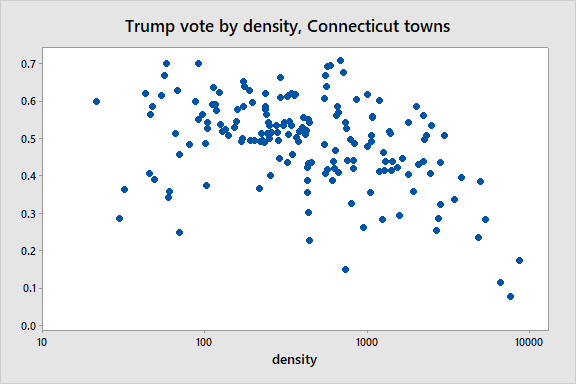
For example, Connecticut is divided into 169 towns: Trump got more votes than Clinton in 81 of those. He won some of them by big margins, getting as much as 68% of the vote (see the map of election results here). What sort of places were they? They tended to be more rural: here is a scatterplot of Republican share of the two-party vote by population density.

What about income? At the state level, there's a substantial negative correlation between average household income and Republican support; among Connecticut towns it was negative but small (-.11). The town data I downloaded also had median household income, and the correlation between with Republican support was only .04. But in an idle moment, I divided mean by median income and found a pretty strong relationship:

Mean divided by median is a measure of skewness, but given the typical distribution of income, it could also be regarded as a measure of inequality--that is, Republican support was lower in places with a bigger gap between the top and the middle. I'm not sure what to make of this relationship, but it seems potentially interesting.
In most accounts, urban/rural differences in Republican support are treated as a matter of economics: rural areas are falling behind, and therefore people feel angry. But Connecticut towns are small, averaging only 25 square miles. Also, even the biggest metropolitan areas in Connecticut aren't all that big. So regardless of where you work, you are in reasonable commuting distance of urban, suburban, or rural places. This point suggests that the urban/rural differences are mostly about preferences--the sort of people who decide to live in low-density areas are the sort of people who vote Republican. This possibility has sometimes been noted, but it hasn't received much attention. I think that's because of the tendency represented by Egan and Abramson--exaggerating the geographical distance between "red" and "blue" America. (I think they also exaggerate the social distance, but that's a topic for another post).
For example, Connecticut is divided into 169 towns: Trump got more votes than Clinton in 81 of those. He won some of them by big margins, getting as much as 68% of the vote (see the map of election results here). What sort of places were they? They tended to be more rural: here is a scatterplot of Republican share of the two-party vote by population density.
What about income? At the state level, there's a substantial negative correlation between average household income and Republican support; among Connecticut towns it was negative but small (-.11). The town data I downloaded also had median household income, and the correlation between with Republican support was only .04. But in an idle moment, I divided mean by median income and found a pretty strong relationship:

Mean divided by median is a measure of skewness, but given the typical distribution of income, it could also be regarded as a measure of inequality--that is, Republican support was lower in places with a bigger gap between the top and the middle. I'm not sure what to make of this relationship, but it seems potentially interesting.
In most accounts, urban/rural differences in Republican support are treated as a matter of economics: rural areas are falling behind, and therefore people feel angry. But Connecticut towns are small, averaging only 25 square miles. Also, even the biggest metropolitan areas in Connecticut aren't all that big. So regardless of where you work, you are in reasonable commuting distance of urban, suburban, or rural places. This point suggests that the urban/rural differences are mostly about preferences--the sort of people who decide to live in low-density areas are the sort of people who vote Republican. This possibility has sometimes been noted, but it hasn't received much attention. I think that's because of the tendency represented by Egan and Abramson--exaggerating the geographical distance between "red" and "blue" America. (I think they also exaggerate the social distance, but that's a topic for another post).
Subscribe to:
Posts (Atom)